Thursday, March 13, 2008

Street-performance hazards and preparations

If you think you're ready to unleash your bagpiping on the general public, there are a few things you'll need to know. This article will brief you and give you some tips to help your busking (performing on the street for money) be less stressful on you.

Local Laws


First of all, you should inquire with your city's arts council on whether they allow bagpipes played in public. Many cities don't permit loud instruments, and most cities designate certain places for performances. Most importantly, some cities require permits. Before you go out in public, you should check out what your town requires you to do. You don't want to accidentally break a law and get harrassed by the cops (even though most cops love pipes).

Lighten the Load


You should limit your load to what you can easily carry in one trip. Your instrument bag, a money-jug, and supplies should easily fit on a small luggage-cart, or on your person. You don't want to make multiple trips to your car, if you're parked far from your spot. Also, if you use public transporation, it is doubly important that you pack lightly.

You should include in your load, some snacks and a jug of water. Piping dehydrates you, and you will get very thirsty while playing, especially if it's summertime. Among your gear, you may be tempted to carry a sign explaining your instrument, or a music stand. Don't bother, unless your sign can stand up to a good wind. I used to take a music stand with me, but it would always blow over. I switched to using a sign that folds out and can be weighted down with a rock in my instrument case.

You should also have business cards. People will always ask for more info as they walk by, or if they wait around for you to stop.

Distance Yourself


Well, you know what you've gotten yourself into, since your instruemnt of choice is loud. You'll need to keep track of where other musicians are around you. If you're the only one, great, but if other people are playing guitar, string quartets, portable keyboards, or other instruments, you don't want to piss them off by drowning them out. If there are rules about scheduling in your city, you'd be best to keep tabs on the other musicians to work out a schedule with them. The best thing to do is give the other musicians a good warning. You may want to walk around and ask them if you're too loud. The more you go out of your way to talk to other performers, the better you will get along with them. Musicians appreciate being given a warning, and will be less likely to be angry if you are.

Move Around


If you have the ability to play every day, don't play in the same place day after day. People nearby will get very annoyed very quickly. Choose several locations, and rotate between them. This way, people will not see you as a constant annoyance, just an infrequent one.

Derelictus Interruptus


We all have to deal with drunks, homeless people, crazy people, mischeivous kids and rude old farts, but we have to know how to deal with them so that they do not bother you or your audience. First of all, select a spot where there are plenty of other people regularly passing through. You don't want to be isolated, because if a violent person assaults you, you'll be left on your own. Sticking to peopled areas with lots of foot traffic not only gets you more money, but offers some potential deterrant to derelicts and whinos who may annoy you. Your audiences may even help shoo them away.

Secondly, If a drunk or insane person tries to talk to you, ignore them, or keep playing. They want to be your friend, and trust me -- you don't want to get acquainted with them. They will either try to take money from you, or they will keep talking to you and distract you. If they persist, you will have to ask them to please stop bugging you, but ignoring them tends to work. Threatening to call the cops or park rangers seems to work well, as many cities have laws against public drunkenness.

I was violently attacked by an insane old fart once, who objected to my costume of all things. Apparently, my medieval robe looked too much like a monk's outfit, and he got some idea that I was impersonating a monk to get religious people to give me money, or some foolish idea like that. He started ranting and raving, and kicked my money-jug away. I told him I'd get the police, and he ran away. The guy must have been in his 80's, too. This can happen, and the best defense is still a populated area.

Talking to People


Talking to people is inevitable, and the only problem is talking for too long. People will have questions about your instrument, if you're in a band, if you've heard of this group or that group, and if you'll play funerals. People always ask me to play amazing grace. The more you talk, the less moeny you'll make, although some people give you a five-dollar bill if you talk with them. If you have a time limit to play in, talking will give you less time.

Learn some Modern Tunes

One way to stir up interest in passers-by is to play an unexpected song. Nobody expects to hear bagpipes playing TV theme songs or 80's pop tunes. I highly recommend learning a few tunes, like Gilligan's Island, The Brady Bunch, and other familiar tunes. People will laugh, and they will appreciate it. You'd be surprised to find out how many times an unexpected tune on bagpipes will draw people near.
Off you go, then!

Remember, it's not just about the money, you're getting valuable practice time. If you're learning new tunes, this will be your way to practice them or test out variations. If you suck, then you may want to wait before busking, but if you are reasonably competent, you should be able to start pulling in $20-$30 an hour playing pipes (well, depending on how many people there are, and whether they actually like bagpipes). Staying safe, prepared, and hydrated is important. Hopefully, this advice had given you enough ideas to avoid common mistakes.

Wednesday, February 27, 2008

Tips for medieval bagpiping

I wrote this article a while ago for Steffan's Florigium (http://www.florigium.org), and I realized that it contains a lot of good links to follow.

Tips for medieval bagpiping in the SCA

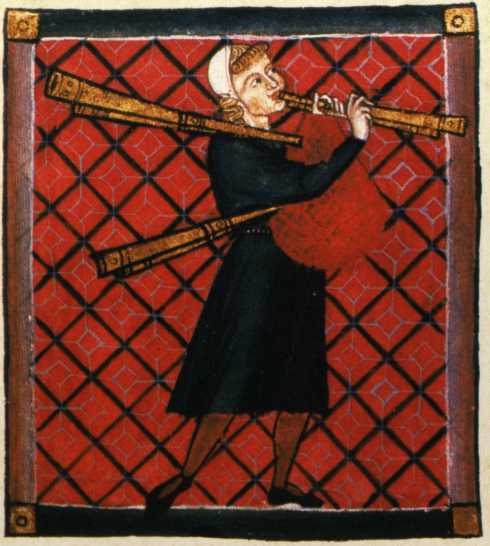
(1) Great Highland Bagpipes are a 17th century instrument. Though you could plug up one drone hole, and just use 2 drones instead of 3, the actual style of the Great Highland pipes, even the "antique chalice" styles seen on many websites, are simply not ancient enough to look like a medieval instrument. It's like playing a metal transverse flute with valves in a renaissance orchestra. You should look for a period instrument. If you could dress your Highland pipes so that they looked like the pipes in medieval art, then go for it. If you are a pre-1600 person, and you wear kilts, then you most likely would be using a 1 or 2 drone instrument. The closest direct ancestor of the Great Highland pipes are the Biniou Kosz from French Brittany. A Spanish Gaita is a close ancestor of the Great Highland pipes that is borderline pre-1600.

Basically, if you cannot afford a real medieval-style bagpipe from a professional craftsman (and let's face it, most people cannot blow $1000 on a music instrument), there are cheap options available. Check E-bay periodically for medieval bagpipes. Avoid Mid-East's Medieval Bagpipes in the Key Of F, as they do not work. These are ubiquitous, so watch for them. Most of the actual cheap, working medieval style bagpipes are either Pakistani-made or German made. Go for German, if you can afford it. They are usually between $300 and $800. There is a certain cheap Pakistani Medieval Bagpipe on the market that has distinctive conical-shaped drones. These bagpipes, which I own a set of, work, but only for people with a lot of experience. I started off playing them with just one drone until I could build up my lung capacity to play both drones.

There are about 2 or 3 cheap "medieval smallpipes" on the market. One is made by Mid East MFG (Pakistani-made, but sold from a warehouse in Florida), and they are in the key of D. Another is made by a company called Airstream, and they are distinguished by their conical drones and a spiral-carved blowpipe. Smallpipes are a lot easier to play, and usually a lot cheaper -- in the under-$200 range.

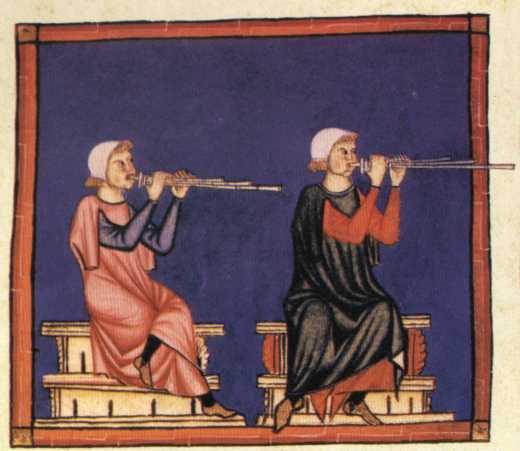
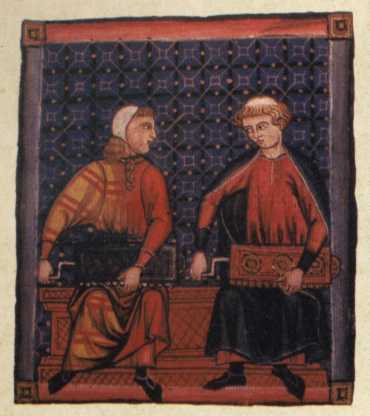
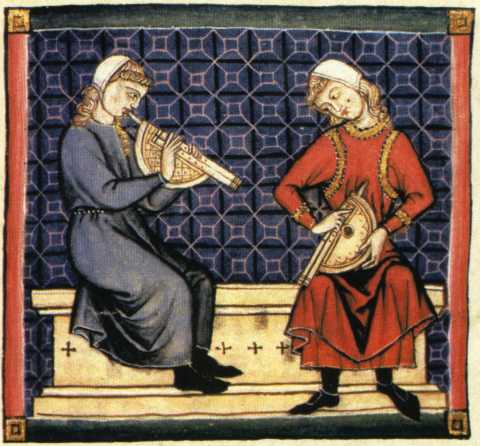
(2) Your costume should be appropriate to the time period you're playing from. If you have 13th century pipes like me, you might want to dress like the people in Cantigas De Santa Maria's illustrations -- robes with tights underneath, maybe a coife. If you are going as a 14th or 15th century German or Italian, you may want to get out your tunic and codpiece, with your puffy-hat. Dress either from the exact same period as

your pipe's design, or LATER. It's arguable that bagpipes and other instruments were passed down from generation to generation. I happen to think they were, since they were expensive and rather durable. There are museums that have actual working medieval instruments, as opposed to reproductions, and if a bagpipe or recorder can be playable 600 years after it was made, then playing your great-grandfather's 100 year-old pipes would be very appropriate.

(3) Play period music! I can't tell you how many times I've been to events where people are playing medieval bagpipes, but are playing modern (post 1600) music on them, and nearly always Scottish music. If you are playing medieval bagpipes, you really need to learn some medieval songs, and stick to them. There's actually thousands of songs available to you, and most are easy to learn. The Scottish Highland music from the 16th to 19th century that most people are familiar with, is highly refined and technical. Medieval music is much simpler, and if you play Highland music fairly well, you should be able to pick up medieval tunes with hardly any work at all. Nearly all medieval music can be played effortlessly on Bagpipes, as the instruments of the time that the music was typically written for, such as recorders, shawms, crumhorns, flutes, etc, use the exact same fingering, and have the same one-octave range. Most people will recognize tunes like Stella Splendens and Ecce Mundi Gaudium, and Greensleeves. It adds to the authenticity of your performance. The songs from the Cantigas De Santa Maria (13th century Spain) and the Carmina Burana, or Buranus Codex (13th century German) provide a plethora of music. You can find sheet music from these two books all over the web, and much of it for free, as it is of historical value.

(4) Drummers are essential! You should have a drummer to accompany you. A lone bagpiper is sad! If you have large, loud pipes, you should get a couple of drummers and some other percussionists with bells, tambourines, or other rhythm instruments. Middle-eastern and African rhythms are very appropriate for a lot of the Spanish music, because of the influence of the Moors. For more northern European music, though, you need to play different beats. English and northern European minstrels could often be found with a Frame Drum (usually called an Bodhran or Irish-drum), and a larger drum similar to a tom-tom (Usually a rope-tension drum with a thick head made of animal skin). The Frame drums were typically used for the overall rhythm, and the tom-tom was used for accenting. If you can get other bagpipers, great, otherwise, just fill up with Rhythms. In many occasions, you will bump into drummers and do impromptu jams with them. This can be fun and useful, as you can test playing songs to different rhythm styles.

(5) Smallpipes, singing, and recorders... One of the problems I encountered with playing smallpipes among other musicians is the musical scales. Most Bagpipes use the Mixolydian scale -- a musical scale that goes back to the Ancient Greeks, and which became replaced by Gregorian, Renaissance, and finally Baroque scales (well, finally, the modern scale). Bagpipes retained the older musical scale because they were considered "folk" instruments, not part of the standard court ensembles of the renaissance and Baroque periods. Essentially, when people playing a Baroque recorder play some notes, the Bagpipe chanter will play a sharp or a flat.

The modern standard on all modern instruments, for the frequency of the A above middle-C is 440 Hz (cycles per second). On medieval instruments, the A above middle C is anywhere from 470Hz to 480 Hz. You will see this a lot when you delve into the technical aspects of music. A Bagpipe's Chanter plays one octave, usually from Low A to high A. Compared to the modern scale, the notes in a Bagpipe's scale sound like A, B, C#, D, E, F#, G, A. The C# and the F# will sound dissonant when played together with a baroque or modern instrument. Of course, if your bagpipe is in a different key (the example provided is the key of B, which most Highland pipes are in), different notes will be sharp, or even flat. Stringed instruments, because they can be fine-tuned, and play in any key that the musician wants, have almost no problem getting along with Bagpipes; The musician only needs to tweak the tuning of a couple of strings, and play normally.

Other early instruments cannot be fine-tuned as easily as stringed instruments. There are several ways to overcome this. One way is to have a bagpipe maker custom-make a set of pipes that is compatible with the baroque scale. Many craftsmen will do this, but it's not something you will find already built into a cheap set of pipes. You have to have the instrument custom-made, so this is an expensive option. Another method is to have the recorder players adapt their playing to play the sharps or flats that your bagpipe does, if possible, or avoid the notes that sound dissonant when played with your bagpipe. This can be difficult, but it can be done. One method that I've heard several professional musical groups use is to play the piece using only the other instruments of the ensemble, while the bagpipes are silent, or with just the drones playing. Then, for the finale of the song, the other instruments stop, and the Bagpipes play alone with just the rhythm instruments. This works extremely well most of the time.

Smallpipes and Singing go together just fine, but forget being heard if big pipes are playing. The band "In Extremo", A Medieval-heavy Metal crossover band, plays big pipes with singing. They accomplish this by not having any singing going on when bagpipes are playing. They alternate between singing and the big pipes. This can easily be done without a heavy metal band. One problem for pipers with equally good singing voices is that you cannot pipe and sing at the same time, and transitioning between playing pipes and singing in the same piece can be a difficult juggling act. It's best to keep the piping and singing separated. Some custom-made pipes have a cut-off valve that allows the player to stop playing instantly, but this is usually just on the chanter. The drones still need to be pumped, which means that you will either have to deal with the sound of the drones losing air pressure (sounds like an airplane going down... or a sick cow), or keep your singing parts quick so you can pump the drones and get back to blowing before they become unstable (Usually, you have about 10-20 seconds of air in the bag to play just the drones). It's hard, and I've never really seen anyone do it, so i don't recommend it. Personally, I would look for other bagpipers to allow you to sing while he plays.

Great accompaniment for large pipes are shawms. Shawms essentially use similar reeds to the large bagpipe's chanter, and are as loud. In fact, medieval German bagpipe chanters are practically identical in construction, shape,and sound to the shawms from the same period. Corvus Corax, one of the most popular contemporary Medieval bands in Germany, uses shawms and bagpipes together with great effect. Though their arrangements are very modern, Corvus Corax's instruments are all authentic, and deliberately custom-made to be in compatible keys.

(6) Final thoughts. I'd like some input on these suggestions. I can be contacted at priscus.forem at gmail,com. I'm interested in hearing from other pipers all the time. Thanks! Please distribute this article only in it's entirety, and with proper credit to the author.

Related Links (where I got most of my info from).


Highland Bagpipe History Links:
------------------------------
History of the Great Highland Bagpipes
The Edinburgh Bagpipe Company
The College Of Piping
The Pre-Seventeenth Century Highland Bagpipe

Medieval Bagpipe history links:
------------------------------
Bagpipes in Germany

Bagpipe historical illustrations:
--------------------------------
Bagpipes and Shawms

Cantigas:
--------

Cantigas De Santa Maria illustrations Index
Launeddas
Hurdy-Gurdy/Symphonia
Strange Double-flute with resonator
Bagpipes

Wikipedia on Cantigas De Santa Maria
The Cantigas De Santa Maria

Carmina Burana (Burana Codex):
-----------------------------
Wikipedia entry for Carmina burana
The Carmina Burana

Online text of the Carmina Burana
Carmina Burana Online

Historical Bagpipe Illustrations:
--------------------------------
Bagpipe Iconography page (large collection of medieval bagpipe images)
the Bagpipe Iconography page


Places to buy Medieval Bagpipes from:
------------------------------------
The best bargain in Medieval Smallpipes:
Medieval Smallpipes in D from Mid-East Ethnic Music

Alternative link for same set of pipes:
Same pipes as above from a different vendor

The medieval Bagpipes in F, which you should avoid at all cost:
Medieval Bagpipes IN F from Mid-East Ethnic Music

Alternative link to same set of pipes:
Same pipes as above from a different vendor

Dancing Stickmen (Bagpipe Craftsman)
Sam Coulter made a nice Hummelchen for me (link is now dead, hopefully Sam isn't!

Stefan Fischer, Sackpfeifenmacher (German) -- Makes a variety of Medieval and Renaissance era bagpipes
Stefan Fischer, Sackpfeifenmacher (German)

Jens Guenzel (IN German and English) -- Makes most famous Medieval Bagpipes
Jens Guenzel Dudelsack Werkstatt (German, limited English text)

Folkster Music Netshop -- Some interesting offerings
Folkster Music Netshop">Folkster (German)

Andreas Rogge (German and English) -- Some really nice and versetile pipes
Andreas Rogge (German and English)

Von Huene Workshop, The Early Music Shop of New England -- Boston's finest repository of early music instruments. He doesn't have bagpipes, but he occaisionally gets shawms, Rauschpfeifs, and other instruments.
Von Huene Workshop, The Early Music Shop of New England

Paul Beekhuizen's Early Woodwind Instruments -- A few authentic designs
Paul Beekhuizen's Early Woodwind Instruments

England's Early Music Shop, LTD -- EMS has many kits for hobbyists to assemble and play.
England's Early Music Shop, LTD
------

Tuesday, January 15, 2008

My Christmas Bagpipe tale...

On Christmas day, 2006, I had a real Christmas moment, the kind that they usually make after-school specials about. It's all about Piping, so I'll share it with you.

For the last 20 years or so, my family has gathered at my oldest sister's house, who goes through great trouble to make a well-organized, Martha Stewart-esque dinner party where everything is intricately prepared and the food is painstakingly displayed on cute little arrangements. Ever the Emily Post afficionado, she sends out Christmas cards, inviting everyone to attend, but I always found this
unnecesary, since we always went there every year without failure.

Now I've been playing bagpipes for the last few years, and as a special treat (mostly for me), I'd show up at family gatherings with my pipes and play them as guests arrived, or intermittantly during the gathering, for fun. Every year I know more and more songs, and this year I practiced a whole bunch of Christmas tunes. So I was all set to have a lot of fun, and I went to my sister's house early in the afternoon at the time I thought we were supposed to show up.

Now my sister, because she was such a Martha Stewart clone, had to have everything perfect. She was always the anal-retentive one, expecting everyone to follow all the proper etiquette, and expecting everything to follow the set plan. I apparently arrived too early, and she gave me this look, as though I just ran over her dog or something. I asked "What? Am I too early?" Instead of being polite and saying "well, yeah, you're early, but make yourself at home, and everyone will get here at
their own time," she got all upset and started yelling at me "Don't you know what RSVP means? I asked that everyone RSVP in my Christmas card, so I'd knw how many people to make food for. You didn't RSVP, so how was I supposed to know you would show up?!" Now it's true that I blew off the RSVP, and it could have been perceived by the Emily Post crowd as disrespect to her, but her reaction was totally mean and rude. For about 5 full minutes, she scolded me, as though I were a child who got
caught with his hands in the cookie jar or something. I was shocked at her over-the-top reaction to what I consider to be a minor misunderstanding.

As she rattled off one put down after another, I simply got angry, but maintained my composure. I waited for a pause in her berating, and finally got one. Not wanting to make an already bad situation worse, I simply took all the presents I had, put them on the counter in front of her, and left, saying "Here's your stuff, Bye!". I
got into my car and drove off.

My sister had always been sort of a bitch, ever since I was a kid. I guess she was always disappointed that the rest of us -- my other sister, two brothers, and myself -- ended up being less Ozzie-and-Harriet types of families than her "perfect little family". She was the conservative one, listening to Rush Limbaugh, going to church, and beign exactly what June and Ward Cleaver dictated. I never had a good time at her house when we went there for holidays -- so stuffy and proper, it was too much work to be there, because nobody could really relax. That she would treat her own relatives like that was unusual, but expected. She was always the kind of person who would complain about other people's imperfections, and I often got mouthfuls of her disapproving rants from time to time. But we're adults now, and this kind of scolding was for kids. I drove off my anger an headed to the beach, hoping to get some take out chinese food and just enjoy myself in spite of her. I convinced myself that I should show up later when everyone else had arrived, and just ignore her. So I parked my car at the beach, and figured I'd warm up my bagpipes before showing up again.

So there I am, playing on a deserted beach to a flock of seagulls, playing the Christmas songs I knew, and other tunes, until my pipes got in tune and stayed stable. It was an unusually warm day for a new England Winter, and my fingers weren't really getting too cold. Then a few people -- a man, his wife, and 2 children, showed up on the beach and watched me while I played. A few more people showed up, two couples, one old, one young. Soon I had about 8 people swaying and listening to my music. I changed from Christmas music and just started playing my usual renaissance faire songs. An older man and his daughter drove up, parked their car, and got out and walked up to stand with the rest of the crowd. I broke into
the Feuertanz (Fire Dance) Totentanz, and a few other dance tunes, and the couples all started to dance in circles. They really were enjoying this, and I was, too. The old man just stared with a delighted expression on his face, and his daughter stood attentively by his side.

Eventually, the wind picked up a bit, and my fingers got cold, and I had to stop playing. I put my pipes back into their case, while people applauded, and went on their way, saying thanks, and expressing appreciation. The old man walked up to me, and said "Oh, I love bagpipes! I listen to CDs of them all the time! This is the first time I got to hear them live and up close! They're wonderful!"

I was very flattered by all of this, he looked longingly at me, and asked if I could play a few more tunes for him. I thought for a moment, and decided "Why not?" So I pulled the pipes back out of my case, and blew into the bag, and started playing again. Another couple showed up with a camcorder, and tehre was more dancing, including the old man, who took his daughter by the arm, and danced in a circle with her. After a few tunes, the old man had tears in his eyes, and just had the look on his face of a man who was very emotionally moved. I stopped playing, and he applauded, tears streaming down his cheeks, and his daughter holding him by the arm. The other people left, and I started to put the pipes back into their case. The old man's daughter helped him into her car, and she closed the door. She walked up to me, as I zipped up my case, and said "Thank you so much! You made a very sad old
man really happy just now, and I can't thank you enough. His wife died a couple of months ago, and this really made his day!"

I was stunned, flattered, and generally feeling all Roland Dahl-ly or Gene Shepherd-like. Something weird happened. I had a Christmas moment, the type of which fills movie scripts and television melodramas. I had had one of those "I learned the true meaning of Christmas" experiences! I thought to myself, Hmmm. I just had more fun with a bunch of strangers than I ever did at my sister's house. I thought, "Screw my
stuck-up sister! I'm going to go hang out with my friends now!" So I got back into my car, and called my pals up on my cell-phone, and went over their house, and we made our own holiday. We ate KFC, watched Movies, made music, and later on, my girlfriend joined us and we had Egg Nog and Vodka, while watching action/adventure movie DVDs. This was simply the best Christmas I had in ages.

Monday, January 14, 2008

From Practice Chanter to Ffirst Set of Pipes

If you're aware of medieval bagpipes, then I probably don't have to tell you that there's dozens of other types of bagpipes available in the world. unfortunately, in the USA, our piping heritage comes primarily from England, and Highland pipes are so ubiquitous here, because we have lots of English, Irish, and Scottish people here, who like to keep their heritage alive, and a lot of that involves kilts, Great Highland pipes, dance and ancient British languages like Gaelic.

If you want to have any bagpipe other than Great Highland, in the USA, you will hit a lot of dead ends, and feel as though you're left in the cold. Don't worry. I'm writing this to let you jump over that part, and just go right for what you're looking for.

Big Pipes or Smallpipes?


You have many options for your first set of pipes. What you want to do is decide if you want smallpipes or big pipes. The difference is that big pipes, like Highland pipes, are more difficult to play than small pipes, and some people just don't have the lung capacity or coordination to keep it up. Don't be intimidated by the big pipes, as you may find that you do have a knack for them -- I only found out after sheer determination and about a year of trying. Hopefully I can help you avoid waiting that long.

The evil key of B-flat


Among smallpipes, there are many types -- Border pipes, Uileann pipes, musettes, and others. Most of these pipes familar to dealers of Highland pipes come in the key of B-flat. All practice chanters come in B-flat. Don't bother looking for a practice chanter in a different key -- They don't make them in other keys, unless you have a custom-made one. B-flat is a terrible key. Most medieval music in in the key of C, D, F, G, and A-minor. B-flat will be an obstacle to you when you start playing medieval music, because you will have to adjust your fingering to play in other keys, and thus, have one less note on your scale.

The Solution? Buy a recorder!


The practice chanter is set up with Highland Fingering, which is different from the baroque fingering that a set of medieval pipes will use. Baroque fingering is typically what you use when playing recorders, crummharns, and other medieval and baroque period wind instruments. You really do need a practice chanter to learn the pipes, as far as dealing with blowing continuously, and dealing with gracenotes. What you should do is buy a cheap plastic recorder, in addition to your practice chanter. Yamaha, Gill, Angel, and other manufacturers make excellent recorders for less than $10. Here is why you need the recorder: You will practice your breathing and playing on the practice chanter, then you will use the recorder to learn the fingering that you will need on your non-b-flat set of pipes.

I'm Cheap!


Pipes are expensive. Medieval pipes can be more expensive, since they're less common these days. Don't think of your first set of pipes as the only set you'll buy. There's no need to commit to a good, expensive set of pipes until you are absolutely sure what you want to end up playing. When you got your driver's license, you didn't go out and buy a $40,000 lurury car, did you? No, your first car was a beater -- a second-hand car with dents, dings, and well, cheap enough so that you weren't going to pay for it for the rest of your youth. Do the same thing with your first set of pipes. Look on craig's list or Ebay for used pipes, if you can. Remember -- these are pipes you will learn on, and that includes learning how to properly care for them (which some people call "learning how NOT to take care for them", if you get my drift...).

It's doubtful that you'll find a good set of used "medieval" pipes for sale, for reasons I've already mentioned. Don't worry. What you need is playing experience, experience using and setting up pipes. If you can find pipes in a key other than B-flat, especially in the keys I mention above, those are good possible choices. Do research on the features and sounds of the pipes you see online. Make sure that they're not proprietary -- make sure you can get the reeds for them without knowing how to make or modify your own reeds.

Beware of Crappy Pipes


I mentioned in my first article that Mid-east has a good set of medieval smallpies. They are good, and if you have $130 - $160 (The average retail price range for that model), get them. But watch out for their large "Medieval Bagpipes". They are junk, although they look nice. First of all, the large Medieval pipes they offer are less expensive than the smallpipes. Go figure. The problem with the big pipes is that they are in the key of F, but you only get a B-flat reed meant for Highland pipes. This combination does not work. Secondly, the holes are rough and full of splinters. Holes on the wood of a music instrument should be all smooth, otherwise they don't play the right tones. The joints are all leaky -- bagpipes need to be ait-tight. With a lot of work -- and I mean re-tooling, re-boring some holes, sanding, and re-hemping all the joints, and having a reedmaker custome make a reed for you, you can get them to work, but that will be a descision you'll have to make for yourself. Avoid those pipes if you don't want to spend weeks working on them.

My first set of pipes were in B-flat, unfortunately, but they helped me figure out how to play large pipes. Sure, I had to be a solo musician for a while, but these pipes -- which cost me about $300, were ultra-cheap, looked medieval, and were a good cheap way to pick up the skills needed to play most large pipes. Since I couldn't play along with other musicians, I tended to play mostly with drummers and other percussionists. Mostly, I played alone, as you will likely do, because you don't want people to hear you playing until you actually get reasonably good at it... Or maybe you do? Heck, even I know some people I'd like to play pipes badly around, just to drive them crazy!

Until you're confident that you can buy a good professional set of pipes, you may want to stick to local vendors -- find the nearest babpipe suppliers in your area, and see if they actually have models to demonstrate. The more local, the easier it will be to get support and information for when things go wrong.

Saturday, January 12, 2008

Greetings!

You're here because you either heard about my band, Diabolis In Musica, or you were inspired by a European Medieval band, and want to learn more about Medieval Bagpipes. No matter how you ended up reading this, this blog will attempt to chronicle what I have learned about Medieval Bagpiping, and bagpiping in general.

I was first inspired by a German band called In Extremo. A pen-pal of mine sent me some of their music, and I was hooked. When I found out that the cool sound I was hearing were these giant-ass medieval bagpipes, I thought "I have to get me one of those!" So I searched for my local cranky Scotch Bagpipe supplier, and bought a good practice chanter. I found that playing bagpipes was a lot easier than I thought. The chanter is not too different from playing a recorder, but obviously you need a lot more wind to keep it going. Within a year, I have learned about 20 or so odd songs, and figured it was time to buy my first set of pipes.

My first set of pipes were the cheap ones that you get online from Mid East Ethnic Instruments, and everyone I talked to advised against anything so cheap from that kind of company. Of course, they were all Highland Pipers, and didn't understand that these pipes were jsut what I was looking for.

My knowledge of how to set them up was not there, and it took me about a year to figure out how to properly set them up and use them. Eventually, I got them working completely, and even found good plastic reeds for them. Soon I was thinking about some big pipes.

Inside the USA, there are very few options for pipers who seek non-highland pipes. There are only a couple of makers of them in the USA, and well, what they make is limited. None of the people I met in the USA makes the giant-ass German pipes I was looking for, so I eventually had to get them from Germany. Before I got enough money for my German pipes, though, I played around with Pakistani bagpipes, and got a nice set of Highland pipes that were designed to look like medieval pipes. I struggled with those for about a year before I got enough wind to play them, and only when I could play them with Both Drone going for an hour without stopping did I know I was ready for the Big German pipes.

In the process, I became a music instrument seller and importer, joined the SCA, met the girl of my dreams, started a music trend, became a musical entertainer at renaissance festivals, did a ton of traveling, and formed a band of strange musicians in the Boston area who all had the same ideas I had for medieval music done differently... HOLY CRAP! Now that I think about all of this, I really did quite a lot of stuff in the last 3 or 4 years! There I was thinking my life was stagnant!

My future bloggings will try to give instruction and advice to the aspiring medieval pipers out there who share my dream. Playing bagpipes can be easy if you work hard at it, it will surely be a challenge on many levels, no matter how talented you are already. You will make enemies out of neighbors when you practice, cause dogs run away in terror, make some people cry, make others smile, and whinos in public parks will want to be your friends -- but more on that later.

Welcome to my world. Medieval bagpipes... Oh, shit... Just what the hell have you gotten yourself into...??